Of all the cleanliness standards a bulk carrier’s holds might need to meet, grain standard is the least forgiving. Operators preparing a vessel for grain loading need to understand exactly what “grain standard” means in practice, not just as a line in a charter party, but as a physical condition a surveyor will actually check, and as a regulatory requirement with a paper trail attached.
Here’s a practical breakdown for technical managers and operators preparing a vessel for grain loading, wherever the port call happens to be.
The regulation behind the term
“Grain standard” isn’t a phrase the IMSBC Code uses, the IMSBC Code explicitly excludes grain from its scope. Bulk grain is governed separately by the International Code for the Safe Carriage of Grain in Bulk (the Grain Code), given force under SOLAS Chapter VI. Any ship loading grain must hold a Document of Authorization confirming it can meet the Code’s stability requirements for the intended voyage; without one, the master has to demonstrate compliance to the port’s Administration before loading can start.
The cleanliness bar itself comes from a different source: the industry-accepted definition of “grain clean,” most commonly attributed to the US National Cargo Bureau (NCB), which independent surveyors worldwide apply as the de facto standard regardless of flag or load port. NCB’s definition is specific, compartments must be completely clean, dry, odour-free, and gas-free, a fourth criterion that’s easy to overlook alongside the more visible checks for scale and residue. Where NCB or an equivalent recognised organisation attends, the process runs in two stages: a Certificate of Readiness issued once the holds pass pre-loading inspection, followed by a Certificate of Loading once cargo is aboard and stability is confirmed against the grain loading manual.
What’s changing in 2026: amendments to the Grain Code adopted by IMO’s Maritime Safety Committee (Resolution MSC.552(108)) enter into force on 1 January 2026, adding a fourth permissible loading condition to address partly filled compartments on modern bulk carrier designs. The amendments apply automatically to newbuildings and can be adopted voluntarily by existing ships to gain loading flexibility. It doesn’t change the cleanliness bar covered below, but operators should expect updated grain loading manuals and Documents of Authorization to start referencing it through the year.
What “grain standard” actually means
Grain standard is a defined cleanliness level, not a general description. Holds must be:
- Free of loose rust scale, paint flakes, and residue from any previous cargo
- Completely dry, with no standing water or damp patches in corners, bilges, or under frames
- Odor-free, including no lingering smell from cleaning chemicals, and gas-free
- Free of insect or rodent evidence, and free of bird droppings or other animal filth, a strict requirement given grain’s status as a foodstuff cargo
The insect threshold is stricter than most operators expect: a hold is typically declared unfit if three or more insects, dead or alive, are found in a single hold, and unfit outright if any larvae or unhatched eggs turn up, regardless of count.
The test surveyors commonly use for surface cleanliness is simple but unforgiving: running a light-colored glove across bulkheads, frames, and the tank top. Any discoloration on the glove is grounds for rejection, regardless of how clean the hold looks by eye.
Why grain standard is stricter than “swept” or “shovel clean”
Charter parties use several cleanliness terms, and it’s worth being precise about the difference:
- Shovel clean, only cargo that’s easily accessible needs to be removed; residue can remain in less accessible areas.
- Swept clean, a more thorough sweep, but still short of full washing.
- Grain standard, the highest routine standard in dry bulk trade, requiring the hold to be washed, rinsed, and fully dried, with every corner and frame checked.
Confusing these terms, or assuming “clean” means grain standard by default, is one of the most common sources of disputes between charterers and owners at load port.
What determines whether you’ll need it
Two questions decide the scope of work:
- What was the previous cargo? Coal, petcoke, and other staining cargoes almost always require chemical washing before grain standard is achievable. A clean prior cargo, like steel products, may only need a lighter wash and thorough dry-out.
- What does the charter party specify? Some fixtures state grain standard explicitly; others simply say “clean and dry in accordance with cargo requirements,” which in practice usually means grain standard once the receiver is confirmed. When in doubt, confirm directly with the charterer before the vessel arrives, not after the surveyor is on deck.
The grain standard process, step by step
A properly run grain standard clean typically follows this sequence:
- Dry sweep, removal of loose cargo residue, dunnage, and lashing material
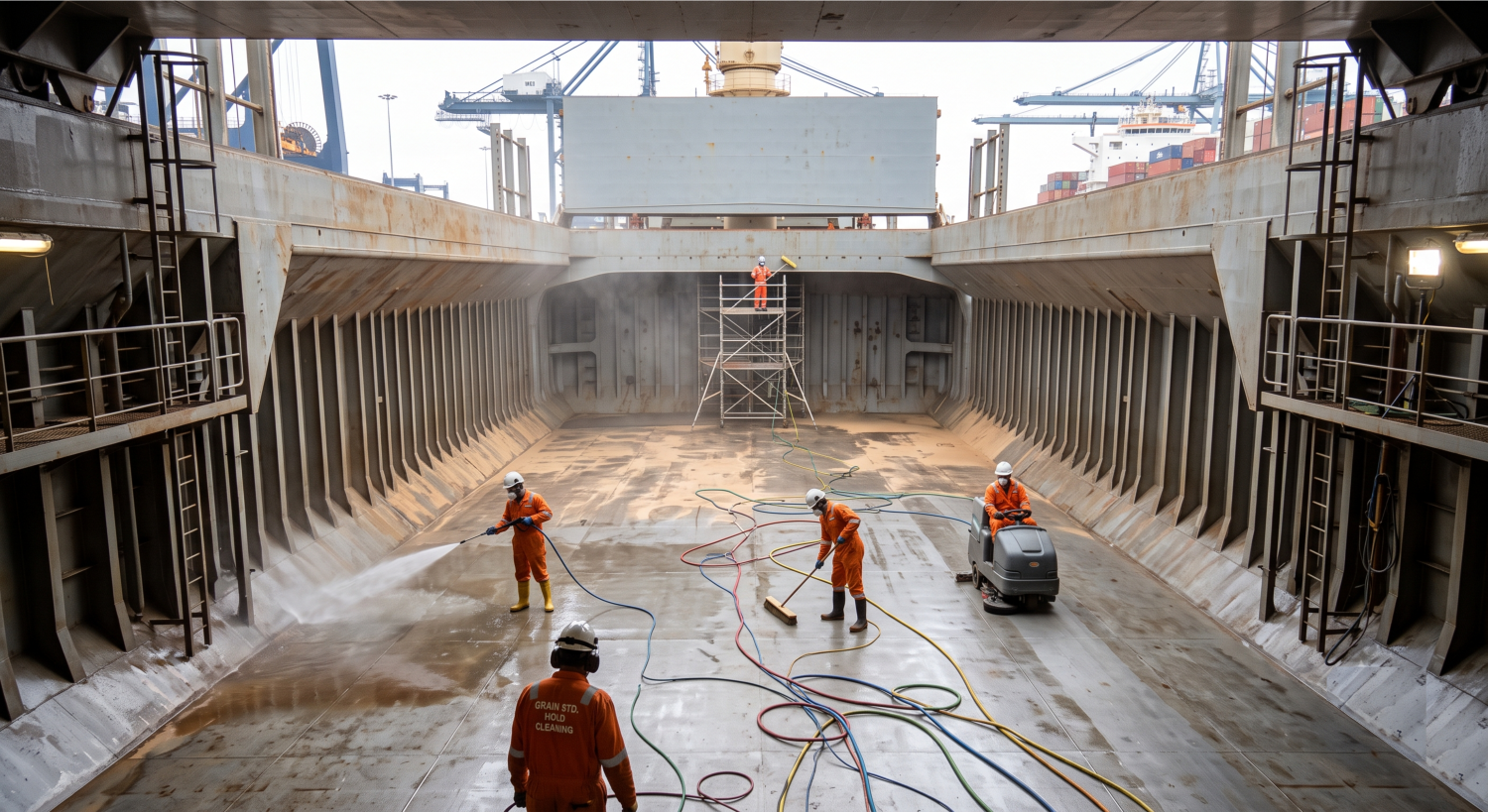
- Wash down, high-pressure seawater washing of all surfaces, including underdeck frames and hopper areas
- Chemical treatment (if required), targeted application for staining cargoes like coal or petcoke, followed by a full rinse
- Freshwater rinse, removes salt deposits that would otherwise corrode surfaces and contaminate the next cargo
- Drying and ventilation, holds must be fully dry before inspection; damp corners are one of the most common causes of a failed first attempt
- Inspection and documentation, a walk-down covering every zone, followed by a Confirmation of Work with photographic evidence, and where an independent surveyor attends, the Certificate of Readiness that clears the vessel to load
Skipping or rushing steps 4 and 5 is the most frequent reason a hold fails on first inspection and needs re-cleaning, which costs both time and money in a port with limited spare hours.
| Grain standard self-check Is your hold ready for grain loading? Answer 8 quick questions about the previous cargo, the charter party, and what you see on a walk-down. Get a straight read on where you stand before the surveyor does. |
What a failed inspection actually costs
A first-attempt failure isn’t just a paperwork setback. Industry data on hold rejections puts the direct cost of re-cleaning, re-survey, and associated delay at roughly $10,000 to $50,000 per incident, with average delays around 2.4 days once a hold is rejected and has to be redone. On a Panamax or Supramax with a tight laycan, that’s frequently the difference between a clean load and an off-hire dispute with the charterer. It’s also the strongest argument for getting the previous-cargo and charter party questions above answered before the vessel arrives, not after the surveyor has already walked the holds once.
Timing considerations worth planning around
Whether the job happens at anchorage or alongside berth changes the logistics. Anchorage attendance needs equipment and chemicals mobilized by launch in advance, with no opportunity to fetch something forgotten. If the previous cargo requires chemical cleaning, build in extra time, coal-to-grain transitions in particular routinely take longer than operators expect when the port stay was planned around a simple sweep.
The bottom line
Grain standard isn’t a formality, it’s a specific, checkable condition, defined by an industry standard and backed by SOLAS-referenced regulation, that either passes or fails on inspection. Confirming the requirement early, understanding what the previous cargo demands, and working with a team that documents each step properly are what keep a grain-standard clean from becoming a source of delay.
INNERHULL provides grain standard hold cleaning across Greece, Turkey, Singapore, Brazil, and the UAE, using the same procedures and reporting format applied in every market, so the standard your holds meet is the same one they’ll meet anywhere else we operate.
Request a quote for grain standard cleaning →
Sources consulted
- International Code for the Safe Carriage of Grain in Bulk (International Grain Code) — IMO
- Key Amendments To The International Grain Code — Marine Insight
- Amendments to the International Code for the Safe Carriage of Grain in Bulk — DNV
- International Maritime Solid Bulk Cargoes (IMSBC) Code — IMO
- Grain Certificate of Readiness — National Cargo Bureau
- Grain Certificate of Loading — National Cargo Bureau
- Document of Authorization to Carry Grain: A Handy Guide — Navsregs
- Hold Cleanliness: Surveyor’s Inspection and Requirements — Marine Surveyor Information
- Cargo hold cleaning standards in bulk carrier — Bulk Carrier Guide
- Hold Rejections — a margin killer in grain trading — Marcura