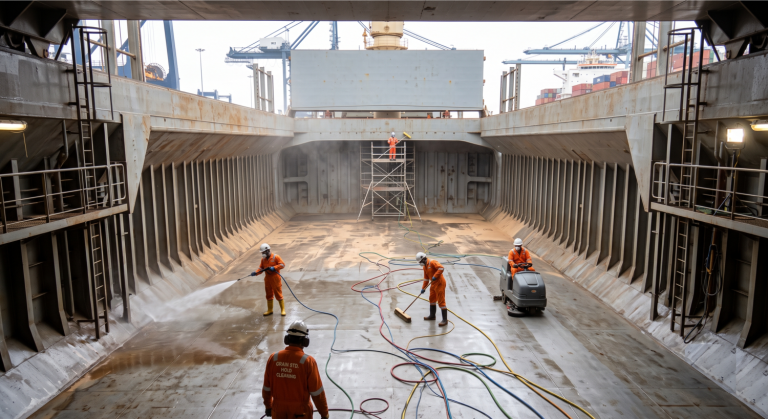
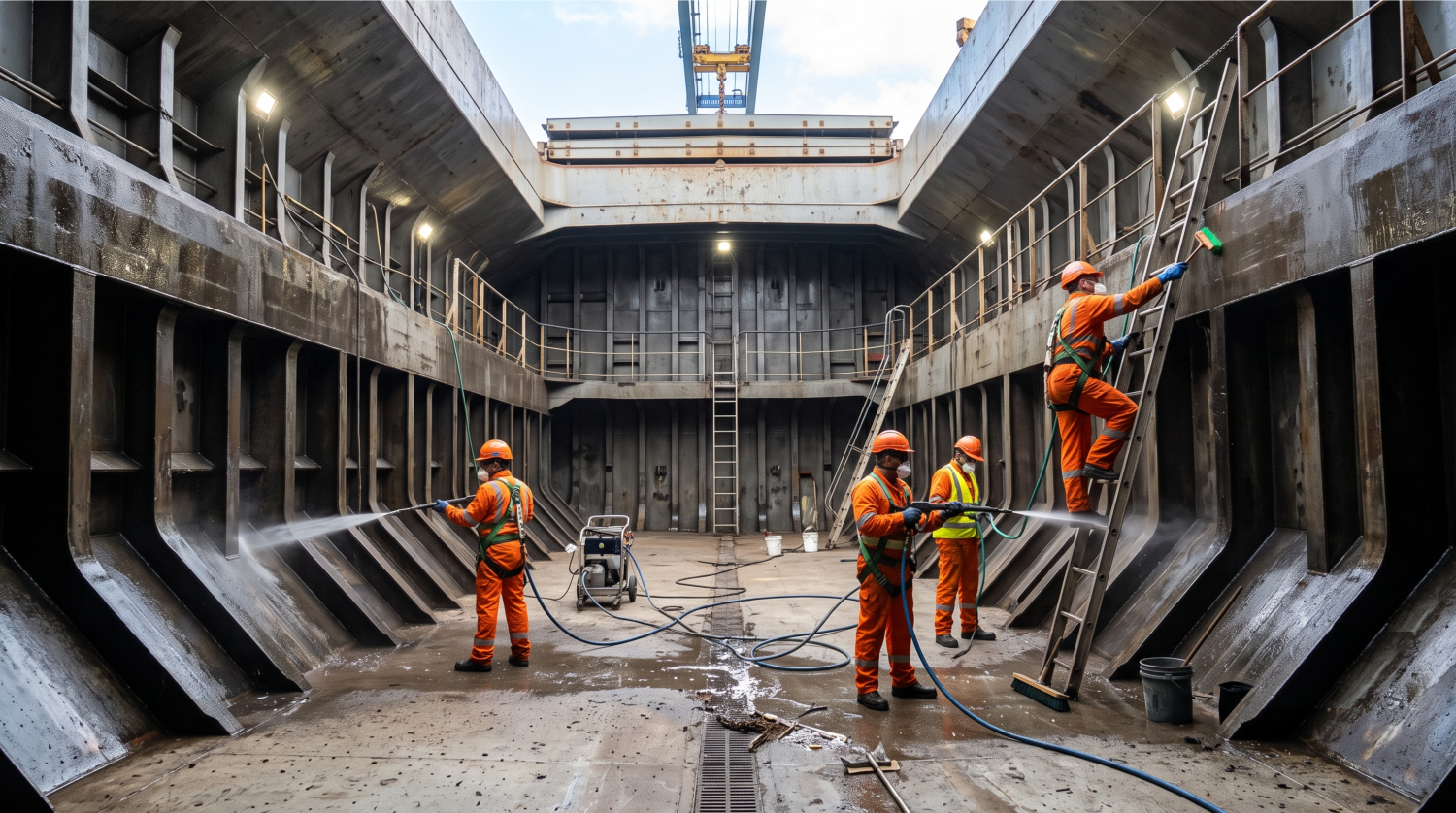
A practical guide for ship operators on what determines your cargo hold cleaning requirement, how fast a team can mobilize, and what to have ready before arrival.
For bulk carriers moving grain, minerals, and general dry cargo between ports, cargo hold cleaning is very often the one variable standing between a smooth port call and a costly delay. Port windows are tight almost everywhere, and a hold that isn’t ready when the surveyor arrives can turn a routine call into an off-hire dispute.
Here’s what operators, technical managers, and masters should know before the vessel arrives, wherever the port call happens to be.
Why hold cleaning requirements aren’t one-size-fits-all
The standard your holds need to meet depends on three things, not one:
- The previous cargo. Coal, petcoke, and other “dirty” bulk cargoes leave staining and residue that require chemical washing, not just a sweep. Clean cargoes like steel products may only need dunnage removal and a final sweep.
- The next cargo. Grain is unforgiving. If the vessel is loading grain, holds typically need to meet grain standard, no loose rust, no residues, no odors, and surfaces dry enough to pass a glove test.
- The charter party. Some fixtures specify “swept clean,” others “shovel clean,” others explicitly grain standard. It’s worth confirming exactly what’s required with charterers before the vessel arrives, not after the surveyor is already on deck.
Getting this wrong is one of the most common causes of off-hire disputes and failed inspections in the dry bulk trade, and it’s almost always avoidable with early planning.
Anchorage or alongside – plan for both
Hold cleaning happens both at anchorage and alongside berth, and the logistics differ. Anchorage attendance means the cleaning team needs to be mobilized by launch, with equipment and chemicals coordinated in advance, there’s no walking back to the terminal for something forgotten. Alongside work is generally more flexible on access but still runs against the vessel’s loading schedule.
Confirming which scenario applies as early as possible in the port call gives the cleaning team time to plan the right approach rather than improvising on short notice.
What to have ready before the vessel arrives
A few things speed everything up once the vessel is in port:
- Confirm the cleaning standard required with your charterer or operator in writing.
- Share the previous cargo type with your cleaning contractor as early as possible, this determines whether chemical cleaning is needed and how long it will take.
- Give realistic ETA and berth/anchorage details so the team can mobilize on time rather than waiting for confirmation.
- Ask what documentation you’ll receive. A proper Confirmation of Work with before-and-after photographic evidence protects you if the receiver or surveyor raises a query later.
- Build in a buffer for chemical cleaning cargoes. Coal-to-grain transitions, in particular, take longer than a straightforward sweep, don’t assume the port stay length is fixed if the previous cargo was a dirty one.
Why standardized reporting matters more than it seems
A cleaning job is only as useful as the paperwork behind it. When a surveyor or terminal representative raises a question about hold condition, having a clear, consistent report, scope of work, before/after photos, and a straightforward pass confirmation, resolves it in minutes instead of hours. This matters even more for operators running multiple vessels through different ports, where inconsistent reporting formats between contractors make it harder to track fleet-wide compliance.
The bottom line
Hold cleaning doesn’t have to be a source of uncertainty in your port rotation. Confirming the required standard early, sharing accurate cargo history, and working with a team that documents its work properly are the three things that consistently keep hold cleaning from becoming a delay.
INNERHULL provides cargo hold cleaning across Greece, Turkey, Singapore, Brazil, and the UAE, with authorized local teams operating under the same procedures and reporting format in every market, so wherever your fleet calls next, the standard doesn’t change.
Request a quote for your next port call →
Corporate Registry & Presence
🏢
Headquarters
124 Kifissias Avenue, Maroussi, 15125 Athens, Greece